

Why Hotels Are Choosing Personal Over Scale : The Case for CultSwitch
The channel management market has consolidated hard over the past decade. A handful of large, venture-backed platforms now dominate the conversation, competing on the size of their channel catalogs and the polish of their dashboards. For many independent hotels, hostels, and small groups, that scale has come at a cost: support tickets sitting in a queue for days, onboarding built for an average customer rather than their specific property, and a channel list that looks impressive on paper but is thin exactly where it matters for their market.
CultSwitch, with 20+ years of experience takes a different position. Instead of competing purely on breadth, it competes on depth: the quality of the relationship with each hotel, the relevance of the channel connections it offers, and the willingness to build access that the large, standardized platforms simply don’t prioritize.
Software Plus a Dedicated Team, Not Just a Dashboard
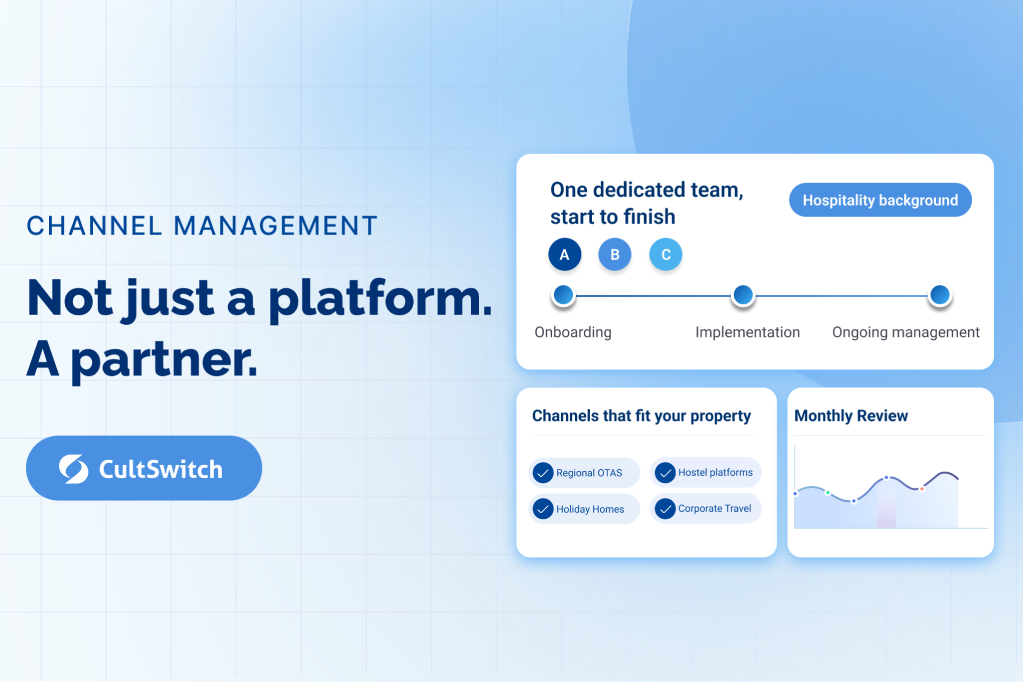
CultSwitch describes itself as state-of-the-art software combined with personal care and professional advice, and that combination is the core of its pitch. Every account gets a team with a hospitality background rather than a rotating support queue, and the relationship follows a defined arc: onboarding to analyze the property’s setup, channels, and pricing opportunities; implementation to connect the PMS, optimize content, and activate channels; and ongoing management built around monthly performance reviews and adjustments to strategy.
Hotel partners describe the effect of that model in similar terms: fast, competent help from the same people over time, rather than starting from scratch with a new agent on every enquiry. One long-time customer noted that even after years on the platform, any issue that does come up gets resolved with immediate, direct help rather than a ticketing process. That kind of continuity is hard to deliver at the scale of a platform serving tens of thousands of accounts through a shared support layer, and it’s a large part of why smaller hotels stay with a channel manager once they’ve found one that actually knows their property.
CultSwitch also builds its technology entirely in-house, which the team points to as the reason updates, security fixes, and custom configurations can move faster than platforms dependent on third-party infrastructure or acquired codebases.
Localized and Specialized Channels, Not Just a Dashboard
The other half of the argument is about the channels themselves. CultSwitch’s own OTA overview makes this distinction explicit: alongside the industry’s key global players, the list includes providers that specialize in a particular accommodation type or focus on a particular region, and CultSwitch positions itself as helping each property figure out which of those fit its actual portfolio, rather than pushing the same standard channel mix to every customer.
That matters because large channel managers tend to prioritize the OTAs with the biggest global volume, since that’s what serves the largest share of their customer base. It leaves a gap for:
Regionally focused OTAs and metasearch partners that matter enormously for a specific source market but never make it onto a generic “top channels” list built for a global average customer. Segment-specialized channels for hostels, holiday homes and apartments, or boutique independents, where a generalist platform’s standard connections don’t reflect how that type of property actually gets booked. Exclusive corporate travel platforms CultSwitch’s own segmentation reflects this: it builds distinct value propositions for independent hotels, hostels, holiday homes and apartments, and small hotel groups managing multiple properties centrally, rather than treating all accommodation types as the same integration problem.
What This Means for Hotels Choosing a Channel Manager
The decision hotels face isn’t really “big platform versus small platform.” It’s a question of what kind of partner actually moves the needle on distribution performance:
Do you need a platform, or do you need a partner?
If your property has a straightforward setup and rarely runs into issues, scale and self-service tooling may be enough. If your operation is more complex, or resolution speed matters when something breaks, a channel manager built around service depth is worth the trade-off. Does your channel mix reflect your actual source markets? It’s worth auditing whether your current channel manager connects you to the regional and segment-specific channels that drive real bookings for your property type, not just the global names every hotel already has.
Is your channel manager negotiating on your behalf?
Access to specialized or regionally focused channels doesn’t happen by default. It’s the result of a channel management house actively building and maintaining those partnerships, which is easier to do at a scale where each connection still matters to the business. CultSwitch was built around this thesis: that a channel manager’s job is not just to move rates and availability, but to give hotels distribution options and a level of support that scale-first platforms are structurally less equipped to provide. For independent hotels, hostels, holiday homes, and small groups navigating fragmented, competitive markets, that combination of personal service and targeted channel access is often the difference between a channel manager that merely functions and one that actively contributes to revenue.